
Lecture • 19 November 2025
Mapping Geographies Through International Art Exhibitions in Divided Europe with Matteo Bertelé
The Art History and Theory specialisation within the Faculty of Visual Arts and Design (FAVD) at the George Enescu National University of Arts, Iași (UNAGE Iași), in partnership with the Institute for Multidisciplinary Research in Art (ICMA), organised a public lecture delivered by Matteo Bertelé, Associate Professor of Contemporary Art History at Ca’ Foscari University of Venice. Entitled Mapping Geographies Through International Art Exhibitions in Divided Europe, the lecture took place on 19 November 2025 in Hall A.0.1, Building A, FAVD, UNAGE Iași. It was open to students, academic staff, and the wider public, and was held in English.
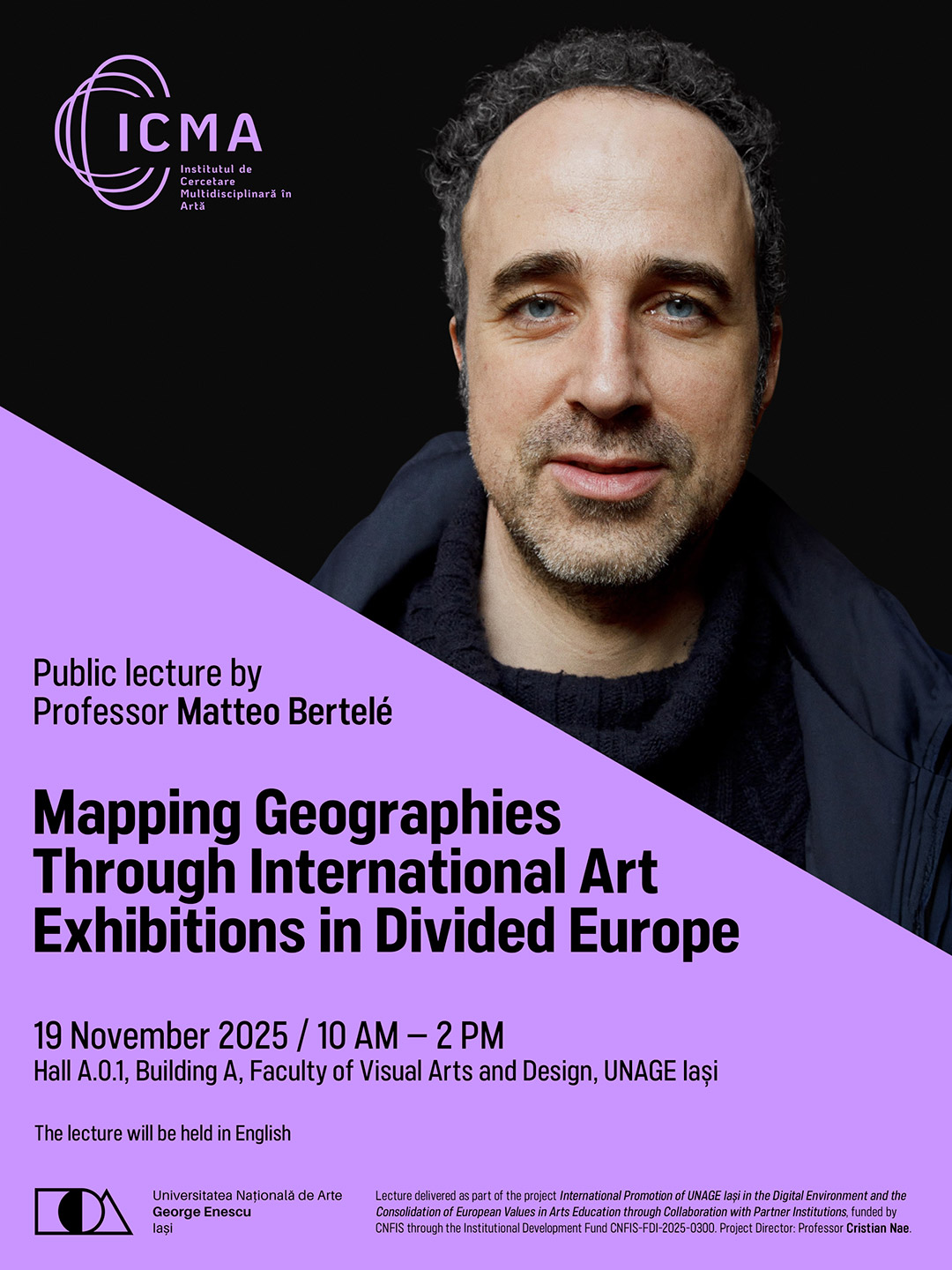
The lecture focused on what have been described as ‘large-scale perennial exhibitions of contemporary art’ (The Biennial Reader, 2010) held in the second half of the 1950s in a divided Europe. At the height of the Cold War, 1955 marked a pivotal moment in the history of biennials, as the year in which a series of initiatives was launched that inaugurated, on a global scale, a wave of biennialisation (Green, Gardner, Biennials, Triennials and documenta, 2016, p. 83).
In Western Europe, ten years after the end of the Second World War, two defeated nations deployed exhibitions as tools for reconciliation and integration. This occurred in 1955 in Kassel, with the establishment of documenta as an attempt to reinstate German culture within the international art community, and in 1956 at the Venice Biennale (already at its fifth post-war edition), with the participation of an unprecedented number of states. Among these were countries from the socialist East, which at that time were undergoing transformations in the wake of the so-called cultural thaw. On the one hand, Poland presented modernist artists in its pavilion, seeking to emancipate its national culture from Soviet socialist realism by embracing the dominant currents of Western European art. On the other, the Soviet Union hosted initiatives such as the first (and only) Exhibition of Socialist Countries (1958), designed to affirm its internationalist aura. With the establishment of the Ljubljana Biennial of Graphic Arts in 1955, Yugoslavia opened up a ‘third way’ in exhibition practice, promoting an ideologically non-aligned initiative.
Building on such examples, the lecture went on to investigate the policies pursued by both established and newly founded international art exhibitions, highlighting the ways in which they mapped new geographies of art as means of integration or emancipation, inclusion or exclusion. Finally, it underscored the extent to which these initiatives adopted different scales (local, regional, national, international, internationalist, supranational) in addressing and defining new audiences in Cold War divided Europe.
Matteo Bertelé is Associate Professor of Contemporary Art History at Ca’ Foscari University of Venice. He is currently a project researcher at the Getty Research Institute in Los Angeles and an associate scholar at the Kunsthistorisches Institut in Florence. He serves as executive director of the Summer School Contemporary art and curatorship: from documenta to the Biennale and as director of the contemporary art section of the academic journal Venezia Arti. His research interests encompass Russian, Soviet, and socialist art and visual cultures, exhibition studies, and the cultural dimensions of the Cold War.
Lecture delivered as part of the project International Promotion of UNAGE Iași in the Digital Environment and the Consolidation of European Values in Arts Education through Collaboration with Partner Institutions, funded by the Romanian National Commission for the Financing of Higher Education (CNFIS) through the Institutional Development Fund (FDI), under grant no. CNFIS-FDI-2025-0300.
Project Director: Professor Cristian Nae.