
Exhibition • 9–14 December 2025
Group Exhibition: Imperatives of Social Change
The Mural Art specialisation within the Faculty of Visual Arts and Design (FAVD) at the George Enescu National University of Arts, Iași (UNAGE Iași), in partnership with the Institute for Multidisciplinary Research in Art (ICMA), announces the group exhibition Imperatives of Social Change.
The exhibiting artists are: Dan Acostioaei, Andrei Nacu, Ștefan Rusu, Andrei Timofte
Curators: Dan Acostioaei and Andrei Timofte
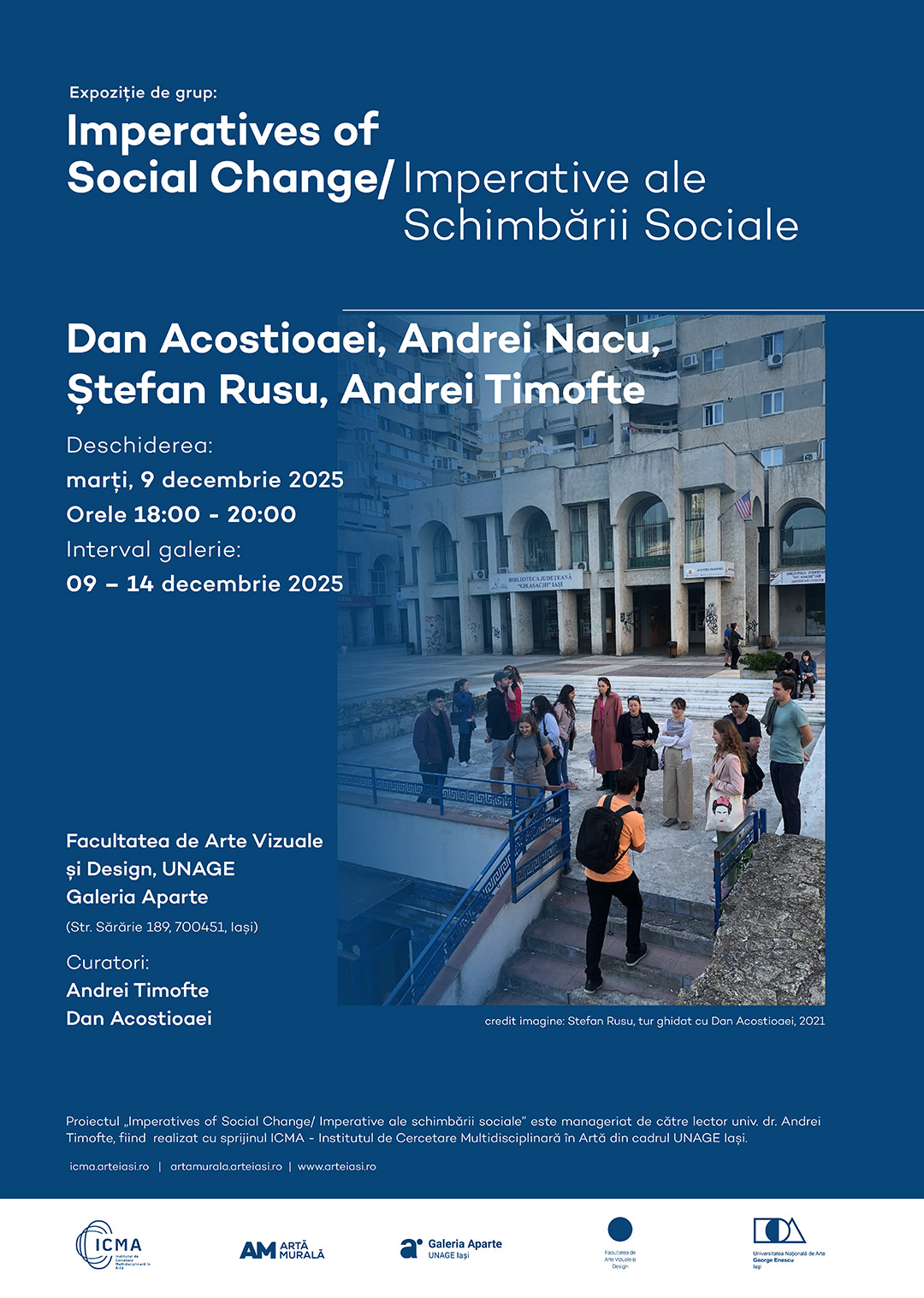
9–14 December 2025
The opening will take place on 9 December at 6.00 pm
apARTe Gallery, FAVD UNAGE Iași
189 Sărărie Street, Iași
The exhibition Imperatives of Social Change foregrounds the capacity of art to generate dialogue, cohesion and social change at a historical moment marked by crises and humanitarian inequalities. The artistic project has been articulated through teaching, research and creative activities focused on strengthening critical and analytical thinking, reclaiming urban space, fostering collaborative practices and affirming the humanist capacity of art to effect social transformation, all oriented towards imagining a future based on solidarity. Within this collaborative process, artists Dan Acostioaei, Andrei Nacu, Ștefan Rusu and Andrei Timofte have mapped the critical potential of art to catalyse social change, to recover shared histories, to interrogate the politics of discursive and visual production, to support the democratisation of public space and to (re)consolidate academic freedom, understood as an imperative of institutional critique. The question that runs through the project is: in what ways does social change manifest itself in artistic practices and in research on the commons?
From this perspective, the ceramic façades reproduced by Dan Acostioaei, both as outcomes of his artistic research process and as a manifestation of his concern with consolidating a horizontal pedagogy, function as pretexts for the artist’s assumption of a social mission of redistributing and co-producing knowledge. When technical and conceptual means are asserted and understood within a collective framework, even when they remain implicated in a continuous relation of symbolic and financial valorisation specific to the circulation of artworks, artistic extraction and commodification become imminent, unfolding in close connection with the institutionalisation of knowledge.
In the same vein, the archival prints N 44° 55’ 2.23’’ E 25° 27’ 22.456’’ (2018), produced by Andrei Nacu, address both the mediated nature of historical memory and the contemporary position of the viewer in relation to the decisive moment of the 1989 Romanian Revolution. Drawing on film material from the Romanian Television Archive – part of the collection The Romanian Revolution Live – the artist extracts, edits and sculpturally transforms the only ten-second recording that documents the execution of Nicolae and Elena Ceaușescu on 25 December 1989. By transposing this video fragment into three dimensions, Nacu explores the ways in which the memory of the events of 1989 continues to be perceived and reconfigured in the present.
In his silent video work Except in the Context of Time… (2017), whose performative and poetic dimension is essential, Nacu deliberately accelerates the flow of water, making use of the territorial configuration of the river Prut, which forms a three-kilometre loop near the Sculeni customs point on the border between Romania and the Republic of Moldova. The artist’s seemingly inefficient gesture of attempting to control the river’s natural course, using a rudimentary technological device (a bucket), calls into question the allure of accelerationism. The action, systematically tracked by a drone, enters into a dialogue with the resilience of nature. The historicisation of the Western position of the human as standing outside nature is reaffirmed through the artist’s authorial ethics. It is precisely for this reason that the poetics of the performance is grounded in a decolonial critique, which points towards a more sensitive reconsideration of how we understand life and of our relationship with the living world.
Continuing these interrogations of memory and urban space, the documentary film Partea întunecată a visului (The Dark Side of the Dream, Almaty, 2023), directed by Ștefan Rusu and produced as part of the research project Insular Modernities (Modernități insulare), explores the urban transformations that have taken place in Almaty (Kazakhstan) before and after the 1990s and focuses on the preservation of emblematic buildings of Soviet modernism, designed by renowned modernist architects such as Nikolai Ripinski, Alexandr Korjempo, Albina Petrova, Vladimir Ișcenko, and others. This documentary video essay forms part of a broader series of film-based analyses of modernist architecture in Central Asia (Bishkek, Almaty, Tashkent, and Dushanbe).
The site-specific interventions developed by Ștefan Rusu in Eastern Europe, Asia, and the Caucasus region, such as The Floating Balcony. The Political Sphere Is Not Elsewhere but Here, in Our Kitchens and on Our Balconies, part of the project Performing the Common, realised in Stockholm in 2012, and Apartamentul Deschis (Flat Space), produced by the Oberliht Association, Chișinău, in 2009 and extended in 2016, whose models are presented in the gallery, constitute landmarks of functional social and cultural platforms that repeatedly activate civic positionings and, at the same time, become cultural devices for the political reimagining of the public sphere. His temporary or permanent interventions, such as Apartamentul Deschis (Flat Space), implemented through the logistical support, labour, and unwavering cultural commitment of the Oberliht Association, led by curator Vladimir US, contribute to the activation, rethinking, and reconstruction of public space and of the city, understood as a common good.
In dialogue with these interventions in urban space, the ceramic relief presented by Andrei Timofte brings into relation the devaluation of socialist architecture and decoration with the development of a critical pedagogy ideologically embedded in the present, and with the need to imagine and reconfigure a future grounded in solidarity.
Thus, against the backdrop of the harmful radicalisation of ‘mainstream’ discourses, intensified by the proliferation of fake news and by the normalisation of a condition of ‘passivity in the face of violence’, the artists’ projects reconsider critical tendencies aimed at transforming the public sphere and propose solidaristic and ameliorative configurations that may be articulated in opposition to current austerity policies.
Exhibition produced within the framework of the research project Imperatives of Social Change, funded by the Institute for Multidisciplinary Research in Art at the George Enescu National University of Arts, Iași, through the ICMA–UNAGE internal research grants for 2025.
Project director: Lecturer Andrei Timofte.