Conference • 18–19 March 2022
Emergent Theatre: Distancing, Interaction, and Resilience in 21st-Century Performing Arts
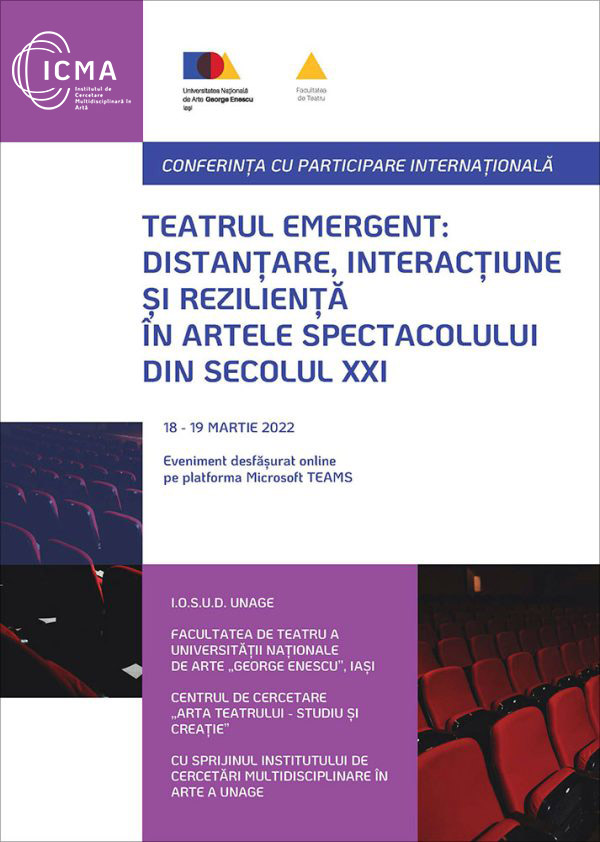
The Faculty of Theatre at the George Enescu National University of Arts, Iași (UNAGE Iași), through the Research Centre “The Art of Theatre: Study and Creation”, in partnership with the Institute for Multidisciplinary Research in Art (ICMA), organised, on 18–19 March 2022, an online international conference entitled Emergent Theatre: Distancing, Interaction, and Resilience in 21st-Century Performing Arts.
“Emergent theatre” is a notion at once highly polyvalent and, in the present moment, distinctly unsettling; at once rich in scope and, at times, potentially restrictive. Widely employed from the 1960s to the present day — when it could serve, by way of equivalence, as a marker of progress or of the evolution of the performing arts — the term has, in more recent years, invited critical detachment, as one takes account of the multiple factors that shape the processes of interaction, distancing, rupture, or retreat within contemporary theatrical forms. Emergent theatre thus calls for a horizontal demarcation: emergent in relation to what — or to whom? In relation to audiences, to the conventions of classical dramatic literature, or to modes of staging and scenic practice? A second nuance, which must also be brought into the discussion, operates vertically, referring either to shifts in the reception of the work of art or to prospective considerations regarding theatre’s becoming over time.
From social theatre to associations that use theatre as a therapeutic instrument or as a driver of social integration; from large-scale productions staged on impressive stages or within immersive environments to the possibility of transposing performances into virtual or online settings, the spectrum of theatrical practices in the 21st century is often marked by hybridisation and multidisciplinarity, as well as by processes of conjunction and disjunction alike.
Moving, as is only natural, from analysis to observation, a series of questions emerges that warrants clarification. One might ask, for instance, whether there are barriers to the consolidation of the new forms and tendencies that theatre now encompasses, or whether there are ways of building a system of resilience — even when artists themselves suspect that, in time, their work may become little more than a footnote in theatre history (Robert Wilson, The Art My Generation Produced Won’t Be Seen in 50 Years, The Guardian, 2016). We might also ask what new relations to spatiality are taking shape within this movement of departure and distancing, accompanied by a persistent need for interaction and recognition, or, conversely, for retreat into cultural matrices. For, if we were to recall today Georg Fuchs’s words — “Every age and every society has the theatre it deserves, and no one, not even the most feared dictator, nor the most influential artist, can force another upon it” (Revolution in the Theatre, 1959) — we may observe that they acquire, perhaps, a note of relativism.
Within the conference, the presentations and discussions revolved around thematic directions such as directorial visions and immersion in digital and online environments; the actor’s art and the art of performance in the context of recent years; current directions in choreographic research; ways of valorising research within the field of the performing arts and the attendant variations in reception; theatre pedagogy and the interdisciplinary meanings of theatrical performance; as well as creativity and applied methods in contemporary performing arts practice.
The conference also formed part of the series initiated by the Faculty of Theatre in 2015 and brought together academic staff, researchers, undergraduate and master’s students, and doctoral candidates with an interest in theatre and the performing arts, all committed to critical reflection on recent transformations in stage practices and the theoretical discourses that accompany them.
Within this framework, the conference pursued a set of overarching objectives: to promote the results of theatre research nationally and internationally; to support and enhance the visibility of early-career researchers; and to sustain dialogue between theatre theorists and practitioners in relation to wider publics. It likewise encouraged the identification of new pathways for innovation in scenic practice, alongside the revitalisation of theoretical resources, and fostered the formation of research teams in the field by bringing together academic staff and doctoral candidates, as well as researchers and professionals active in theatre. Finally, it foregrounded the transdisciplinary directions that traverse the art of theatre and adjacent fields — literature, film, music, philosophy, anthropology, sociology, and so forth — as fertile spaces for articulating shared methodologies and perspectives.
Scientific Committee:
- Irina Niculescu
Vice-President of UNIMA–USA (United States National Centre of the International Union of Puppetry)
- Françoise Flabat
Centre de la Marionnette, Wallonia–Brussels Federation; Professor at Beaux-Arts Tournai
- Scientific Researcher Gabriela Haja
A. Philippide Institute of Romanian Philology, Romanian Academy, Iași
- Associate Professor Radu Apostol
I. L. Caragiale National University of Theatre and Film, Bucharest
- Associate Professor Diana Cozma
Faculty of Theatre and Film, Babeș-Bolyai University, Cluj-Napoca
- Associate Professor Dragoș Varga
Faculty of Letters and Arts, Lucian Blaga University of Sibiu
- Associate Professor Irina Ionescu
Department of Theatre and Visual Arts, University of Arts, Târgu Mureș
- Lecturer Dana Monah
Faculty of Letters, Alexandru Ioan Cuza University of Iași
- Elena Belciu
Programme Coordinator at CINETic, I. L. Caragiale National University of Theatre and Film, Bucharest
- Professor Anca Ciobotaru
Faculty of Theatre, George Enescu National University of Arts, Iași
Organising Team:
- Lecturer Ioana Petcu
Faculty of Theatre, George Enescu National University of Arts, Iași - Lecturer Ioana Bujoreanu
Faculty of Theatre, George Enescu National University of Arts, Iași - Lecturer Carmen Antochi
Faculty of Theatre, George Enescu National University of Arts, Iași - Lecturer Tamara Constantinescu
Faculty of Theatre, George Enescu National University of Arts, Iași - Lecturer Bogdan Anghel
Faculty of Theatre, George Enescu National University of Arts, Iași - Lecturer Sandra Mavhima
Faculty of Theatre, George Enescu National University of Arts, Iași - Scientific Researcher Raluca Zaharia
ICMA, George Enescu National University of Arts, Iași - Assistant Lecturer Cristi Avram
Faculty of Theatre, George Enescu National University of Arts, Iași